
GHK-Cu: Four Decades of Research on the Body's Own Repair Signal
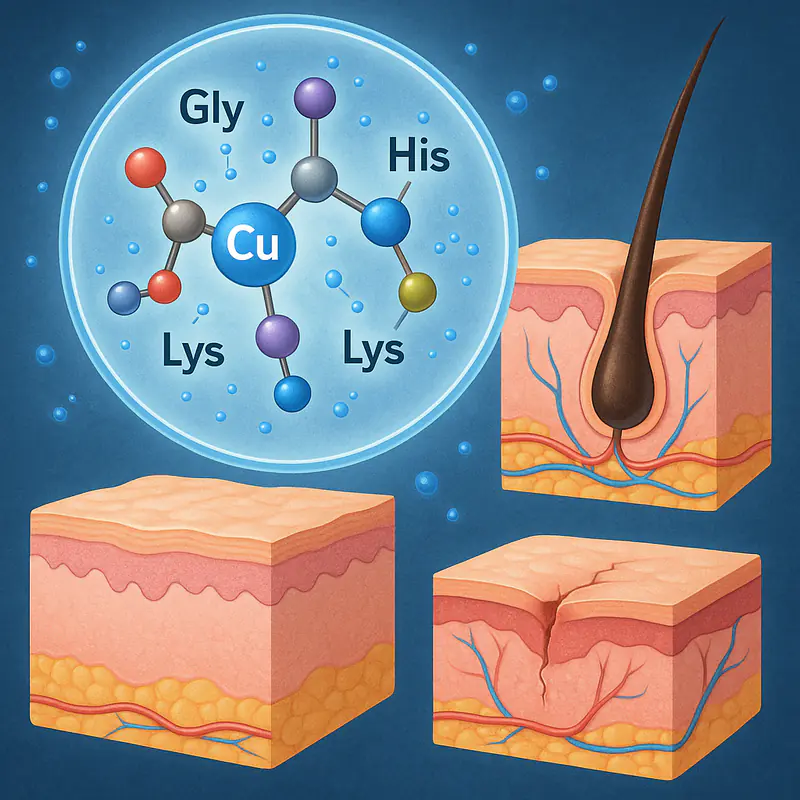
GHK-Cu — the tripeptide Glycine-Histidine-Lysine complexed with a copper ion — was first isolated by Loren Pickart in 1973 from human plasma, where it was identified as the factor responsible for the regenerative capacity of young plasma versus aged plasma in liver tissue cultures. That founding discovery set the direction for what has become one of the most thoroughly documented peptide research profiles in dermatological science.
GHK naturally occurs in human plasma at concentrations of approximately 200 ng/mL in young adults, declining to roughly 80 ng/mL by age 60. This age-dependent decline correlates with progressive deterioration in skin repair capacity, wound healing efficiency, and dermal structural integrity — suggesting that GHK functions as an endogenous repair signal whose loss contributes directly to age-related tissue degeneration.
As a research compound, GHK-Cu offers something unusual: a mechanism directly grounded in endogenous biology, with a research record spanning topical, injectable, and in vitro models across multiple decades and institutions. Understanding the specific mechanisms reveals why it occupies a foundational position in virtually every evidence-based skin optimization protocol.
Collagen Synthesis: Beyond Simple Stimulation
The most cited property of GHK-Cu is collagen stimulation, but framing it this way undersells the specificity of the mechanism. GHK-Cu doesn't simply increase collagen production — it orchestrates a comprehensive extracellular matrix remodeling response that addresses both quantity and structural quality of dermal architecture.
Mechanistically, GHK-Cu promotes synthesis of multiple collagen types, with particular documented effects on Types I, III, and VII. Type I collagen provides the structural tensile strength of adult skin. Type III — more predominant in youthful skin — provides elasticity and a softer texture. Type VII anchors the dermal-epidermal junction, preventing separation and maintaining the structural interface between dermis and epidermis that becomes compromised in aged or damaged skin.
Beyond collagen, GHK-Cu stimulates elastin synthesis, glycosaminoglycan production (including hyaluronic acid and dermatan sulfate), and decorin — a proteoglycan that regulates collagen fibril assembly and spacing. This breadth is significant: collagen fibers without appropriate glycosaminoglycan spacing and decorin regulation form denser, stiffer matrices characteristic of scarring rather than the organized, resilient architecture of young skin.
GHK-Cu simultaneously downregulates the MMP enzymes responsible for degrading existing collagen (particularly MMP-1, MMP-2, and MMP-9) while upregulating TIMP-1 and TIMP-2 — their tissue inhibitors. This dual action — building new structural proteins while slowing breakdown of existing ones — creates net positive remodeling that simple collagen stimulators without MMP regulation cannot achieve.
The Gene Expression Reprogramming Data: GHK-Cu's Most Underappreciated Mechanism
In 2010, Pickart and colleagues published a landmark genomic analysis demonstrating that GHK-Cu modulates expression of over 4,000 human genes — approximately 31% of genes with known functions at the time. The analysis used microarray data to identify GHK-Cu-responsive genes and cluster them by functional category. The findings were striking:
- GHK-Cu upregulated genes involved in cell proliferation, wound repair, and tissue remodeling
- It downregulated genes associated with inflammation, cancer progression, and cellular senescence
- The expression pattern showed a consistent "reset toward youthful state" — genes overexpressed in aged tissue were suppressed; genes underexpressed in aged tissue were upregulated
- The pattern overlapped significantly with the gene expression signatures of low-cancer-risk, long-lived populations
A 2014 analysis cross-referencing GHK-Cu's gene regulation profile against KEGG cancer pathway databases found that GHK-Cu suppressed the genes of five key oncogenic pathways while upregulating tumor suppressor genes — consistent with the peptide's endogenous function as a system-level repair signal rather than a narrow-action compound.
This genomic breadth explains why GHK-Cu's effects extend well beyond skin: the same gene regulatory mechanisms that drive dermal repair also influence vascular function, neurological health, immune regulation, and metabolic processes. Researchers building multi-system optimization protocols — not just dermal protocols — have mechanistic reason to include it as a foundational compound.
Wound Healing: The Original Research Base
GHK-Cu's wound healing profile predates its aesthetic applications and represents its most consistently replicated finding across species and wound types. Multiple controlled studies document:
- Faster re-epithelialization in both partial and full-thickness wounds
- Increased tensile strength of healed tissue at standardized timepoints
- Enhanced angiogenesis in wound beds, improving oxygen and nutrient delivery to repairing tissue
- Significant anti-inflammatory activity during the repair phase, reducing excessive inflammation that would otherwise impair organized healing
- Reduced scarring, with histological analysis showing better-organized collagen architecture in GHK-Cu-treated wounds compared to controls
The anti-inflammatory mechanism is worth understanding in detail. GHK-Cu inhibits the release of oxidation products from copper-containing proteins (a key source of tissue-damaging free radicals in wounds), suppresses TNF-alpha-stimulated ICAM-1 expression on vascular endothelium (reducing inflammatory cell infiltration), and blocks TGF-β1-induced fibrosis — the pathway responsible for hypertrophic scarring when overactivated.
For aesthetic researchers using GHK-Cu post-procedure — after microneedling, fractional laser, or chemical resurfacing — this wound healing profile provides mechanistic justification for improved outcomes: better angiogenesis delivers nutrients to repairing tissue; selective anti-inflammation prevents fibrotic scarring while permitting healing; organized collagen deposition yields improved texture rather than rough repair tissue.
Hair Follicle Activation and Hair Density Research
GHK-Cu's hair research profile is mechanistically distinct from compounds like minoxidil (which operates through vascular/potassium channel mechanisms) or finasteride (DHT blockade). GHK-Cu appears to act through follicle-level biological activation.
Published findings include stimulation of follicular keratinocyte proliferation, enlargement of hair follicle size in treated skin samples, and increased synthesis of versican — a proteoglycan in the follicular dermis associated with anagen (growth phase) induction. In a study comparing GHK-Cu to minoxidil's 5% formulation in male pattern hair loss subjects, topical GHK-Cu outperformed minoxidil on multiple hair density metrics — a finding that, while preliminary, has driven significant researcher interest in the compound.
The mechanism likely involves GHK-Cu's broader effects on dermal fibroblasts in the follicular papilla — the signaling hub that determines follicle cycling. By restoring extracellular matrix composition and signaling competence in the papilla environment, GHK-Cu may restore the follicle's capacity to transition from telogen (resting) to anagen (growth). This differs from compounds that force growth through receptor agonism, instead addressing the biological substrate of follicle function.
Detailed purity documentation, independent testing reports, and supplier comparison data for GHK-Cu research-grade compounds can be found at Peptides Clav, a reference resource used by the research community for evaluating compound quality before protocol implementation.
Antioxidant Upregulation and Copper Metabolism
GHK-Cu's copper component is not merely structural — it actively participates in antioxidant biology. Copper is a required cofactor for copper-zinc superoxide dismutase (Cu/Zn-SOD), one of the body's primary defenses against the superoxide radical. GHK-Cu delivers bioavailable copper directly to tissues, supporting SOD activity in a targeted manner that systemic copper supplementation does not replicate.
Beyond SOD support, GHK-Cu upregulates the expression of multiple antioxidant genes identified in the genomic analysis: catalase, glutathione peroxidase, thioredoxin, and heme oxygenase-1. Heme oxygenase-1 is particularly relevant — it converts pro-oxidant free heme into biliverdin and carbon monoxide, generating potent anti-inflammatory and cytoprotective signals while removing an oxidant. Its upregulation is associated with protection against UV-induced oxidative damage in skin specifically.
The copper paradox worth understanding: free copper ions are pro-oxidant — they participate in Fenton-like reactions that generate hydroxyl radicals. GHK's binding of copper as a chelated complex neutralizes this pro-oxidant potential while preserving copper's enzymatic utility. The peptide effectively creates a "safe copper delivery system" that captures the metabolic benefits of copper biology without the oxidative damage that free ionic copper would generate.
Nervous System and Wound Pain Research
GHK-Cu demonstrates nerve-related effects that are underappreciated in the aesthetic context. Published research documents promotion of nerve regeneration in damaged tissue, reduction of wound pain via mechanisms partially independent of inflammation suppression, and neuroprotective effects in models of nerve injury and oxidative stress.
The pain reduction component has direct aesthetic relevance: post-procedure pain and discomfort are partly driven by inflammatory sensitization of local nociceptors. GHK-Cu's combination of anti-inflammatory activity and direct analgesic-adjacent mechanisms may contribute to improved tolerance of aggressive aesthetic procedures and faster return to normal sensation in treated areas.
Topical vs. Injectable Protocols: What the Research Supports
GHK-Cu's route of administration is a critical variable often underspecified in protocols. As a tripeptide, GHK-Cu faces the general limitation of poor skin penetration when applied to intact skin — molecular weight and charge characteristics limit passive diffusion through the stratum corneum. Published topical studies use GHK-Cu in concentrations ranging from 0.5% to 4%, with penetration enhancement typically achieved through formulation with liposomes, nanoparticles, or co-formulation with penetration enhancers.
The most consistent dermal data comes from studies using GHK-Cu on compromised skin — post-procedure, post-ablation, or in wound contexts where barrier function is temporarily reduced. This is consistent with the clinical practice of applying GHK-Cu serums immediately after microneedling, where the induced microchannels allow transdermal delivery to the dermis where fibroblasts reside.
Injectable GHK-Cu bypasses penetration limitations entirely and has been explored in mesotherapy protocols (intradermal microinjections across a treatment area) and subcutaneous administration. Concentrations used in injectable research typically range from 50–200 mg/mL in solution. For hair applications, scalp injections targeting the follicular dermis are used in mesotherapy practices, though standardized clinical protocols have not been established in peer-reviewed literature.
Researchers comparing injectable vs. topical GHK-Cu protocols in the context of comprehensive peptide stacking can find community-reviewed protocol comparisons at Stack Peptide, where the research community documents administration method data and stacking compatibility across compounds.
Safety Profile and Research Limitations
GHK-Cu's safety profile is among the most favorable of any research peptide. Topical GHK-Cu formulations have been used in cosmetic products for decades with an extensive consumer safety record. The compound is endogenous — the body produces and metabolizes it naturally — which limits off-target concerns. No serious adverse events attributable to GHK-Cu have been reported in published research.
Research limitations include the concentration of foundational mechanistic work in Pickart's group, though subsequent independent research has replicated key findings. The genomic reprogramming data, while striking, requires additional mechanistic characterization of how a short-sequence peptide achieves regulatory effects across thousands of gene targets — the proposed mechanism via chromatin interaction is plausible but not fully characterized. Human RCT data is limited; the hair density comparison to minoxidil is a notable exception but remains a single study.
The injectable research base is thinner than the topical base and the in vitro mechanistic work. Researchers using injectable GHK-Cu protocols are operating with less direct human evidence than topical applications, though the mechanistic logic for injectable routes is sound and consistent with the compound's biological activity.
Conclusion: GHK-Cu as the Evidence-Based Foundation of Aesthetic Peptide Protocols
Among all peptides studied for aesthetic and dermal applications, GHK-Cu has arguably the most thoroughly characterized research profile: four decades of mechanistic data, gene expression studies across thousands of targets, wound healing replications across species, hair density data, antioxidant characterization, and a favorable safety record that extends to commercial cosmetic use. Its mechanisms — collagen and ECM synthesis, MMP regulation, angiogenesis, anti-inflammatory selectivity, antioxidant upregulation, gene expression reprogramming — address the fundamental biology of skin aging at a depth that single-mechanism compounds cannot match.
For researchers building systematic appearance optimization protocols, GHK-Cu's evidence base supports its inclusion as a foundational, not supplementary, component — the compound that addresses dermal architecture broadly while supporting the mechanisms through which other targeted peptides exert their effects.