A research-grounded breakdown of the exact peptides, doses, trial data and cultural forces behind the most-watched looksmaxxing transformation of the decade.
Who Is Clavicular
Braden Peters — known online as Clavicular or KingClavicular — was born December 17, 2005. He began posting looksmaxxing content on TikTok around 2021 and migrated his primary channel to Kick in early 2025, where livestreamed injection sessions and real-time jawline measurements pushed his audience into the millions.
He is not a clinician. He is not a scientist. What he is is the first creator to publicly document — frame by frame, with on-stream bloodwork and progress photography — a multi-peptide protocol built around a phase-2 molecule (retatrutide) that the rest of the world wouldn't see on pharmacy shelves for another year or two.
That's the reason this stack matters beyond the fan base: it's a case study in how a research-peptide protocol escapes the lab and becomes a cultural prescription before a single FDA panel convenes.
Looksmaxxing, Briefly
Looksmaxxing is the disciplined pursuit of maximal physical attractiveness, originating in online forums (notably Looksmax.org) and bleeding into TikTok by the early 2020s. It spans three lanes.
- Softmaxxing — skin care, hair, posture, grooming, body composition.
- Hardmaxxing — surgical interventions: jaw implants, bimaxillary advancement, hairline transplants.
- Pharmamaxxing / Peptidemaxxing — the Clavicular lane: pharmacological tools used to chase aesthetic outcomes that would otherwise require surgery or a decade of disciplined training.
Clavicular's contribution was to systematize the third lane. He didn't invent peptide use. He built a named protocol around it.
The Stack at a Glance
- Retatrutide — fat loss engine — 2 → 12 mg weekly titrated — GLP-1 + GIP + glucagon agonist.
- BPC-157 — gut and recovery backbone — 1.75–3.5 mg weekly — Body Protection Compound acting primarily on the gut.
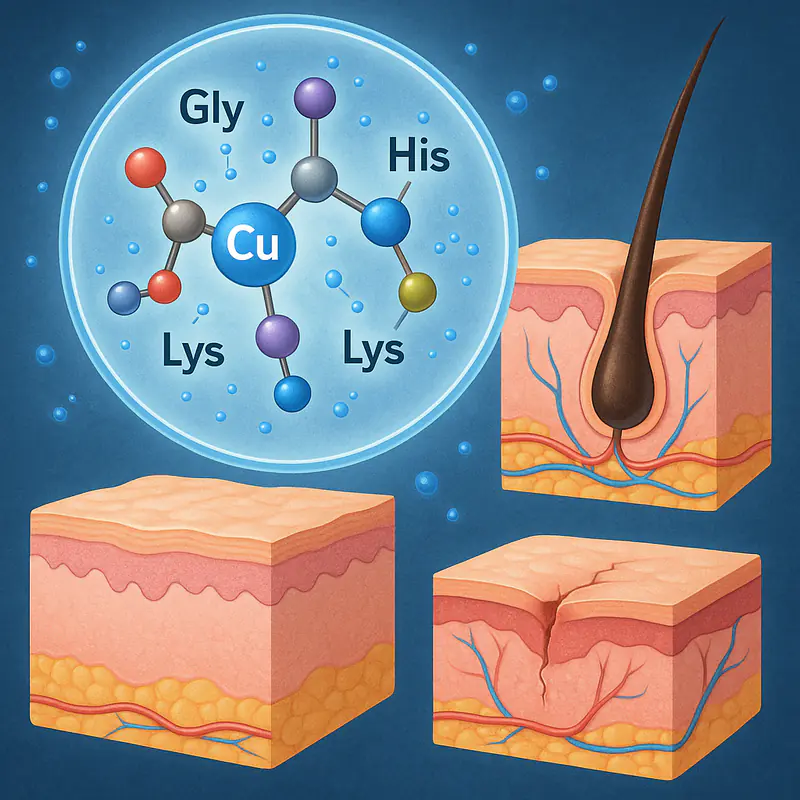
- GHK-Cu — skin, collagen, GLOW — 3–5 mg weekly subQ — 300+ gene regulatory peptide.
- TB-500 — soft-tissue repair — 5 mg loading dose — Thymosin Beta-4 analogue.
- Melanotan II — pigmentation / tan — 0.5 mg ramping — MC1R / MC3R / MC4R agonist.
- SNAP-8 — topical expression lines — daily topical — SNARE-complex inhibitor.
Doses listed were documented publicly by Clavicular in stream and interview. None of this is medical advice — all compounds discussed are sold and intended for in-vitro research only.
Retatrutide: The Triple-Agonist Engine
Why a Third Receptor Changes Everything
Semaglutide activates a single receptor — GLP-1. It remains the pioneer and the benchmark. Tirzepatide added GIP (glucose-dependent insulinotropic polypeptide) and, in SURMOUNT-1, outperformed semaglutide by roughly five percentage points of total body-weight loss.
Retatrutide adds a third: the glucagon receptor. Glucagon agonism directly raises hepatic energy expenditure — your liver starts burning more fuel at rest. It is, mechanistically, the difference between a calorie-restriction aid and a metabolic engine swap.
Phase 2 Data: The −28.7% Figure, Unpacked
The number that launched the stack into the cultural conversation is −28.7% — mean body-weight loss at the 12 mg weekly dose, 48 weeks, in Eli Lilly's phase-2 trial (Jastreboff et al., New England Journal of Medicine, 2023). Phase-3 readouts have tracked closely with the phase-2 curve at equivalent dosing, which is part of why the figure has stuck.
For context, the headline weight-loss numbers in major GLP trials at 48–72 weeks:
- Semaglutide — STEP-1 — −14.9% to −15.3%.
- Tirzepatide — SURMOUNT-1 — −20.9%.
- Retatrutide — Phase 2 — −24.2% on average, −28.7% at the top dose.
Clavicular's Dose-Escalation Schedule
Titration is the entire game with a triple-agonist. Start too high and the GI side effects become incapacitating; titrate too slowly and the cultural impatience around looksmaxxing drives people off protocol. Clav's documented schedule runs as follows.
- Weeks 1 through 4 — 2 mg weekly.
- Weeks 5 through 8 — 4 mg weekly.
- Weeks 9 through 12 — 6 mg weekly.
- Week 13 onward — 8 to 12 mg weekly, held at tolerance ceiling.
Known Side-Effect Profile
Phase-2 adverse-event reporting: nausea (46% at high dose), diarrhea, constipation, reduced appetite (obviously), and — notable for the looksmaxxing use case — transient tachycardia. Clav himself has livestreamed the nausea. He has also repeatedly emphasized that walking the dose down is the only strategy that works; powering through is the fastest way to drop the protocol entirely.
BPC-157: The Recovery Backbone
Mechanism of Action
BPC-157 is a 15-amino-acid sequence isolated from a protective protein found in human gastric juice. In more than 36 preclinical studies across rodent models, the peptide has demonstrated protective effects across the GI tract, tendon and ligament healing, and vascular repair. No minimum toxic dose has been established in published research, which is a remarkably quiet line in the literature for a molecule with this much tissue-level activity.
Why Every Serious Cut Pairs BPC-157 With a GLP
Aggressive GLP-1 / GIP / glucagon agonism produces calorie deficits that shred lean tissue and stress the gut lining. BPC-157 is the guardrail. It doesn't magnify fat loss — it protects the infrastructure (gut, connective tissue, recovery capacity) that an aggressive cut erodes. Without it, most stack adherents drop out around month two with joint pain, GI distress, or both.
GHK-Cu: The GLOW Component
300+ Gene Regulation and Collagen Synthesis
GHK-Cu is a copper-binding tripeptide that Pickart and colleagues have demonstrated modulates the expression of more than 300 human genes — the majority of them associated with tissue remodeling, collagen synthesis, and anti-inflammatory pathways. In practice: upregulated type-I collagen production, downregulated TGF-β-mediated scarring, and measurable improvements in skin elasticity and thickness in split-face trials.
Why the Stack Breaks Without GHK-Cu
Dropping 25% or more of body weight in under a year is the shortest path known to chronic skin laxity. Clavicular's GHK-Cu inclusion is not vanity — it's structural. When you lose weight that fast, GHK-Cu is how you make the new face show well instead of hanging slack off a newly sharp mandible.
Ancillaries: TB-500, Melanotan II, SNAP-8
- TB-500 (Thymosin Beta-4) — soft-tissue repair, often stacked with BPC-157 for athletes running the protocol through a training phase.
- Melanotan II — α-MSH analogue driving pigmentation. Low-dose use in the stack addresses the "pale-and-shredded" aesthetic failure mode that lean-out protocols produce.
- SNAP-8 — topical peptide targeting SNARE-complex expression; reduces fine lines at the brow and forehead. Sits on the face, not the needle table.
How Clavicular Ran It: The 2024–2026 Timeline
- Q3 2024 — begins documenting sub-clinical retatrutide sourcing on private Discord channels and early Kick streams.
- Q1 2025 — first full public protocol post, including dosing spreadsheet, goes viral on Looksmax.org and migrates to TikTok within 72 hours.
- Q2 2025 — adds BPC-157 and GHK-Cu publicly; frames it as the "Clavicular Stack" for the first time.
- Q3 2025 — before and after imagery begins circulating; knock-off vendor pages appear across the research-peptide market.
- Q4 2025 — the now-infamous livestream where he injected his then-17-year-old girlfriend's jawline. Legal and platform response follows.
- Q1 2026 — protocol enters mainstream media coverage via the Indiana Daily Student and others; backlash and adoption continue to grow in parallel.
Risks, Red Flags and the Ethical Reckoning
A few things have to be said clearly.
Retatrutide is not FDA-approved. It is a phase-3 research molecule at time of writing. Everything sold under that name in the research-peptide market is, by legal framing, for in-vitro research use only.
The girlfriend incident matters. Injecting someone — let alone a minor — with an unapproved compound, on a live platform, without a medical license, is a bright-line breach of consent, safety, and criminal-code boundaries. The stack is a research artifact. The behavior that popularized it is not a template.
The "hastemaxxing" critique is real. Loss velocity beyond 1 to 2% of body weight per week produces outcomes (sarcopenia, skin laxity, psychological dysregulation around food) that no peptide on the stack can fully offset.
None of this erases the pharmacology. It frames it.
Sourcing Research-Grade Peptides Responsibly
Ninety percent of the difference between a clean protocol and a failed one is sourcing. A retatrutide vial is only retatrutide if the HPLC certificate says so. The credible vendors in the research-peptide market in 2026 share a specific set of characteristics.
- 98% or higher HPLC purity printed on a lot-specific certificate of analysis (CoA), not a generic brochure.
- Nitrogen-sealed vials shipped cold-chain where the compound requires it.
- Lot-number traceability so the vial in your hand matches a specific HPLC test.
- Clear "for research use only" framing — which, legally, is the standard the entire niche operates under.
A clean reference for deeper product-level research on the compounds in the Clavicular Stack is peptidesmuscle.com — they carry the full range (retatrutide, BPC-157, GHK-Cu, TB-500, Melanotan II) with lot CoAs. Whatever vendor you use, cross-reference the CoA against an independent HPLC database before you put a single milligram on a scale.
What the Clavicular Stack Means for 2026 Looksmaxxing Culture
The cultural shift is larger than the peptides themselves. Two things happened in 2025 and 2026 that have to be understood together.
The looksmaxxing movement matured past cope. Bone-smashing and mewing memes gave way to blood panels, DEXA scans, and phase-2 molecule sourcing. The movement now has a measurement culture it did not have in 2022.
A phase-3 molecule became a cultural prescription. That's the unusual part. The distance between "Eli Lilly trial readout" and "stacked on a Kick stream in a frat house" collapsed to roughly six months.
You can disagree with how Clavicular conducts himself — many of his former supporters do — and still recognize that the protocol he assembled is the single most-replicated peptide stack in the English-speaking internet at time of writing.
The Bottom Line
The Clavicular Stack works because it doesn't try to do one thing with one compound. Retatrutide is the engine; BPC-157 is the gut guardrail; GHK-Cu is the skin insurance policy; the ancillaries fill in the cosmetic edges.
It is also unapproved, under-studied relative to pharmaceutical rigor, and inseparable from the controversy of the man who popularized it. Whether that combination is a template, a cautionary tale, or both depends largely on the honesty of the reader.
What is no longer in question is this: the protocol exists, the data behind its core compound is substantial, and the cultural conversation around it is not going away in 2026.
Research peptides referenced in this article are sold for in-vitro laboratory research only. Not for human consumption, injection, or therapeutic use. This article is journalism, not medical advice. Comply with all regulations in your jurisdiction.